Over the past decade, the concept of neurodiversity affirming practice has had a significant impact across healthcare, community services, education and workplaces.
This shift has been important when it comes to challenging deficit-based understandings of neurodivergence and promoting principles of respect, dignity, autonomy and belonging for neurodivergent people. Neurodiversity affirming practice encourages individuals, professionals and organisations to value neurodivergent differences and recognise them as a natural part of human diversity rather than viewing them as signs of an illness or disorder.
While this represents significant progress and has led to an improvement in services, classrooms and workplaces especially in regards to more inclusive conversations, reduced stigma and improved practices, an important question remains:
Is being neurodiversity affirming enough?
An individual or organisation may genuinely value neurodivergent people while still operating within environments, policies, practices and assumptions that are shaped by neuronormative expectations. Respecting differences does not automatically remove barriers, redistribute power or create meaningful access and participation.
This mirrors the same tensions and issues with moving from culturally aware to culturally responsive practice. Culturally responsive practice acknowledges that while awareness and appreciation of cultural diversity are important foundations, they are not sufficient on their own. It’s not just about being aware of or valuing differences but how to actively respond to it by challenging and transforming systems, addressing biases and attitudes and centering the lived experiences of marginalised communities.
If we apply this same logic to neurodiversity, we must recognise there is a further stage needed beyond awareness and affirming which is neurodiversity responsiveness.
A neurodiversity responsive approach recognises that inclusion and liberation is not achieved through acceptance or awareness alone. It requires ongoing reflection, accountability, collaboration, and systemic change. It requires taking intentional action to identify and dismantle barriers, challenge neuronormativity, redistribute power, and redesign systems.
Importantly, neurodiversity responsiveness is not intended to replace neurodiversity awareness or neurodiversity affirming practice. Instead, it builds upon them. Neurodiversity Awareness provides knowledge. Neurodiversity Affirming provides value and respect. Neurodiversity Responsiveness transforms that knowledge and respect into action and systemic change.
This is about moving from knowing to valuing to responding and acting.
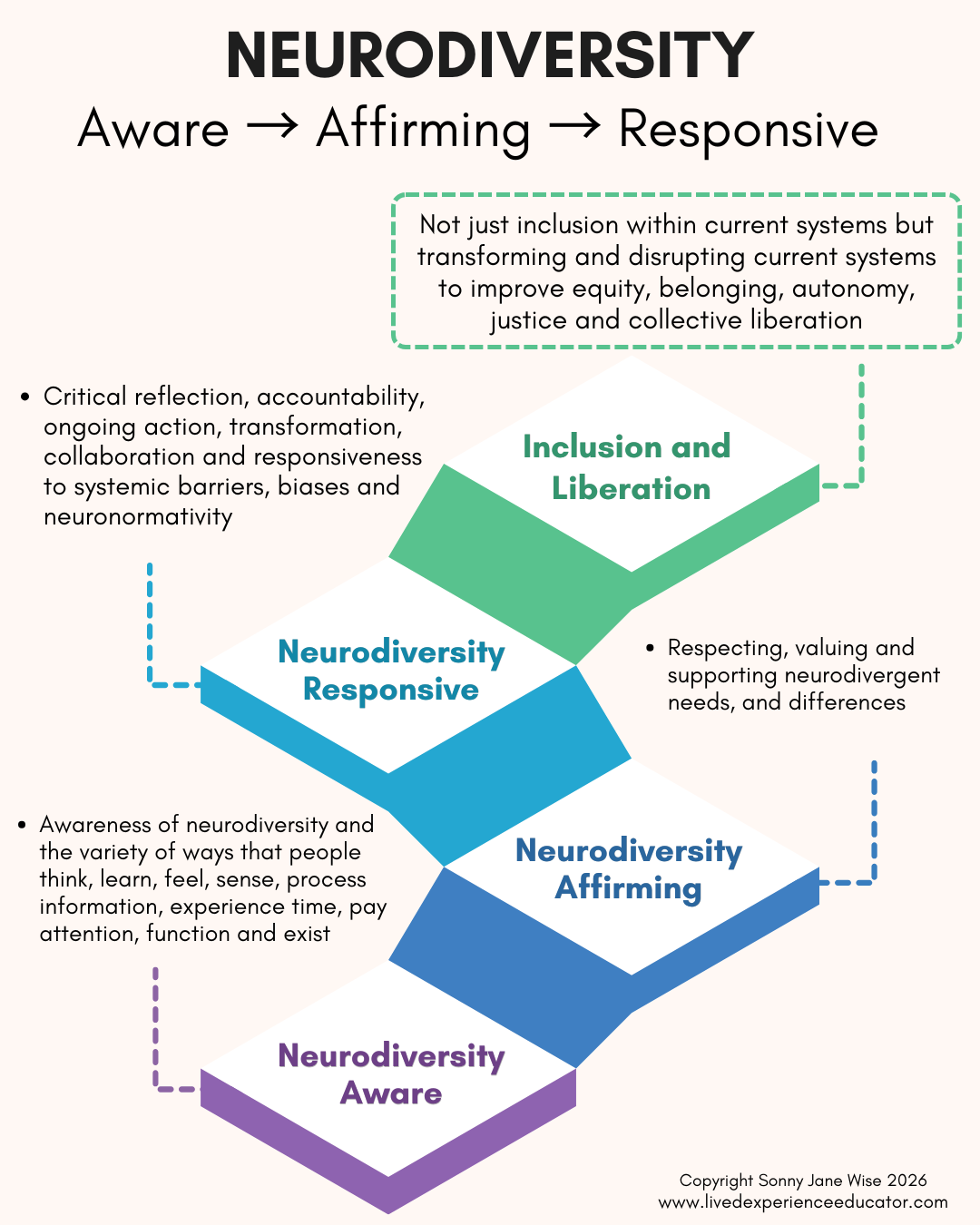
Neurodiversity Aware or Informed:
This is where one is informed or aware about neurodiversity. Individuals, professionals, organisations or businesses are aware of neurodiversity and the diversity of human minds. They understand that people experience, process, communicate, learn, feel, socialise, focus, regulate emotions and navigate the world in different ways.
Awareness is an important starting point, but it doesn’t necessarily lead to changes in attitudes, practices or systems.
Key Characteristics
Basic knowledge of neurodiversity and related concepts
Awareness of the existence of neurodivergent people
Recognition of the diversity of human functioning
Neurodiversity Affirming:
When someone is neurodiversity affirming, they actively value, respect and affirm neurodivergent ways of thinking, communicating, sensing, learning, paying attention, processing, feeling and existing. Instead of viewing neurodivergence as a deficit, disorder or problem to be fixed, they recognise neurodivergent identity, strengths, needs and lived experiences as valid and meaningful.
Neurodiversity affirming practice seeks to support autonomy, self-determination and well-being.
Key Characteristics
Rejection of deficit-based narratives and language
Respect for autonomy, self-advocacy and self-determination
Validation of neurodivergent identities and lived experiences
Recognition of strengths alongside support needs
Commitment to dignity, inclusion and belonging
Neurodiversity responsive:
Neurodiversity responsive moves beyond awareness and valuing into intentional, ongoing action. Drawing on culturally responsive practice, it recognises that inclusion is not achieved by accepting differences but by moving into responsive action.
A neurodiversity responsive individual, professional, organisation or workplace continuously examines and challenges personal and societal assumptions about what is considered "normal," identifies and disrupts neuronormative expectations and works to dismantle barriers that restrict access, participation, and self-determination. This involves adapting environments, policies, practices, relationships, and systems to better respond to the strengths, needs, and lived experience of neurodivergent people.
Neurodiversity responsiveness recognises that meaningful inclusion requires ongoing reflection, collaboration, accountability, redistributing power and systemic transformation. It is not only about valuing neurodivergent people but taking action to create equitable, accessible, and liberatory environments where neurodivergent people can thrive.
Key Characteristics
Active adaptation of environments, systems, policies and practices
Ongoing critical reflection on personal biases, assumptions and neuronormative expectations
Ongoing critical reflection on the relationship between themselves, others and the systems in which we interact
Recognition and disruption of systemic barriers that disadvantage neurodivergent people
Shared decision-making and co-design with neurodivergent people
Responsiveness to individual, cultural and contextual differences
Recognition of intersectionality and the influence of culture, race, gender, disability, socioeconomic status and other identities
Accountability for creating accessible and inclusive environments
Advocacy for systemic and structural change rather than solely individual accommodation
The goal of neurodiversity responsiveness is not just inclusion within current systems but transforming and disrupting current systems to improve equity, belonging, autonomy, justice and collective liberation.
Guiding Questions
A neurodiversity aware person asks:
"What is neurodiversity?"
A neurodiversity affirming person asks:
"How can I respect and support neurodivergent people?"
A neurodiversity responsive person asks:
"What barriers exist, who benefits from current dominant norms and systems, what assumptions and biases do I hold, whose needs and perspectives are being centred or excluded and what needs to change within the system for inclusion and collective liberation?"
In practice
A neurodiversity-aware organisation learns about neurodiversity.
A neurodiversity-affirming organisation values and respects neurodivergent employees.
A neurodiversity responsive organisation redesigns recruitment processes, communication practices, physical spaces, policies and decision-making structures in partnership with neurodivergent people to remove barriers.
If we are committed to genuine inclusion and collective liberation for neurodivergent people, neurodiversity responsiveness cannot be viewed as an optional addition to neurodiversity awareness or neurodiversity affirming practice. It is the necessary next step.
Neurodiversity awareness builds understanding.
Neurodiversity Affirming builds respect.
Neurodiversity Responsiveness creates change.