Neurosupremacy and Hierarchies Within The Neurodivergent Community
Like most communities, the neurodivergent community is not immune to reproducing the same hierarchies they seek to dismantle. As someone who is multiply neurodivergent, this is something I both witness and experience frequently. I call this phenomenon neurosupremacy which I first named and described back in 2024.
Neurosupremacy is the belief that certain neurodivergent people are superior to others, including other neurodivergent people. Neurosupremacy operates internally, within neurodivergent communities and it echoes similar dynamics to ‘aspie supremacy’ but extends to supremacy over other forms of neurodivergence. Neurosupremacy ranks certain forms of neurodivergence as more legitimate, acceptable, valuable and natural than others.
Neurosupremacy asks: which minds count? Which minds are better? Which minds are deserving of acceptance? Which minds are too much? Which minds are too threatening? Which minds should be cured? Which minds are mentally ill? These are the same questions that produced the categories of disordered, abnormal and mentally ill - the same categories we are supposed to be fighting against.
One of the clearest manifestations of neurosupremacy is the policing of who is allowed to identify as neurodivergent. Despite Kassiane Asasumasu (who coined neurodivergent) explicitly including all mental health conditions from the beginning, some people within the neurodivergent community attempt to narrow its definition to those who are ‘born this way’ or those who they deem to have a socially acceptable form of neurodivergence. More often than not, Autism and ADHD are framed as ‘natural differences’ while experiences like altered states such as mania or psychosis, plurality or hearing voices are framed as inherently pathological and therefore, excluded from the neurodivergent umbrella. And this distinction and exclusion is rarely neutral - it reflects a hierarchy in thinking and sanist attitudes that many neurodivergent people are not exempt from.
Neurosupremacy also shows up through assigning moral superiority and moral value to certain forms of neurodivergence and neurodivergent people. Certain neurodivergent people are framed as more empathetic which mistakes high empathy as having higher morals which just isn’t the case at all. Feeling the emotions of other people or experiencing intense emotions does not automatically translate into moral reasoning, ethics, compassion or accountability. People who experience high empathy are not any more moral or more compassionate than those who experience low empathy.
Similar to this is how certain neurodivergent people are framed as possessing heightened justice sensitivity. This trait is often used as evidence that neurodivergent people are more morally superior than neurotypical people or other neurodivergent people. I won’t get into how this isn’t actually a real trait exclusive to Autistic or ADHD people but rather, a presentation of cognitive inflexibility, but I do want to point out how this is yet another example of neurosupremacy.
Another example of neurosupremacy is the belief that only certain neurodivergent people are more deserving of autonomy. Within the neurodivergent community as well as neurodiversity affirming spaces, there is a pervasive assumption that certain neurodivergent people such as people diagnosed with personality disorders, schizophrenia, psychosis, plurality or bipolar are incapable of knowing themselves or making decisions. As a result, our voices are dismissed, our knowledge and lived experience is treated as unreliable, our consent is questioned and our agency is denied. Everything we say is filtered through a presumption of incompetence or doubt, our insights or opinions are treated as symptoms, our resistance is labelled as pathology. If we’re diagnosed with NPD, we’re automatically deemed an unreliable narrator of our own experiences. This assumption reinforces the idea that certain minds must be controlled for their own good. In this sense, neurosupremacy results in ranking who deserves autonomy and who does not.
Another clear example of neurosupremacy is the widespread use of terms such as ‘narcissistic abuse’. This language perpetuates the assumptions that trauma survivors who have been diagnosed with Narcisstic Personality Disorder are inherently abusive. As a catch all term, not only does it harm an entire community of individuals who are survivors of abuse and trauma themselves, it minimises complex experiences of harm and oversimplifies abuse as well as draws attention away from the patterns of power and control. And yet, whenever we call attention to the harm of using such a term, it’s often dismissed, with a prevailing attitude that it is acceptable to stigmatise and dehumanise people with NPD for the sake of having language to describe an experience.
This reflects a hierarchy within neurodivergent spaces in which certain neurodivergent people are afforded compassion, nuance and protection from stigma and generalisation while other neurodivergent people are positioned as undeserving of that same consideration. Just to put it into perspective, the neurodivergent community frequently challenges statements such as ‘they’re so OCD’ or ‘Autistic people lack empathy’ or ‘the weather is so bipolar’ because we recognise the harm caused by using diagnoses as adjectives or by generalising entire groups. Yet when similar generalising statements and terms (such as Narcisstic abuse) are directed towards people diagnosed with a personality disorder, many people don’t bat an eye or worse, they fight for the right to use a generalising and harmful term. This is neurosupremacy in action.
Another example of neurosupremacy in action is the growing belief that neurodivergent people are inherently better than neurotypical people or that neurodivergent people are the next step in human evolution. We’re framed as more ethical, more moral, more authentic, more creative or more empathetic than neurotypical people as if neurotypical people cannot be ethical, moral, authentic, creative or empathetic. Again, this is ranking individuals based on what traits we deem acceptable or superior - the same thing that has been done to us. And I get it, it’s often used as a way to feel better and reclaim a sense of pride when we’ve been made to feel inferior but positioning other people as inferior is not the way to go.
The idea that neurodivergent people are better than neurotypical people flattens both groups. It generalises neurotypical people and romanticises neurodivergence. It also ignores the diversity within both groups (hello, it’s called neurodiversity) and implies that neurodivergent people are inherently more moral or superior. I’m sorry but neurodivergent people can be shit people too.
In addition to this, it risks alienating and excluding neurodivergent people who don’t have high empathy, who aren’t creative, who aren’t articulate, which further marginalises people. In other words, neurosupremacy reproduces the same pattern and hierarchy it’s supposed to reject - some minds are seen as worthy while other minds are seen as inferior or disposable. Ultimately, neurosupremacy replaces one hierarchy with another hierarchy rather than dismantling hierarchies altogether.
I’ve even seen suggestions that we should replace neurodivergent with neurosuperior (a suggestion I’ve seen multiple times on LinkedIn). Again, this reflects the same hierarchical thinking that pathologises neurodivergent people as it positions one group of people as superior than another group of people.
No mind is better or more superior than another mind. That’s neurodiversity 101.
In order to challenge neurosupremacy and truly be neurodiversity affirming, we need to return to the radical roots of neurodiversity - we need to reject all hierarchies of minds, functioning and worth. We need to stop ranking individuals according to palatability, comfort, legitimacy and productivity and we need to stop sorting people into ‘good neurodivergence’ and ‘bad neurodivergence’.
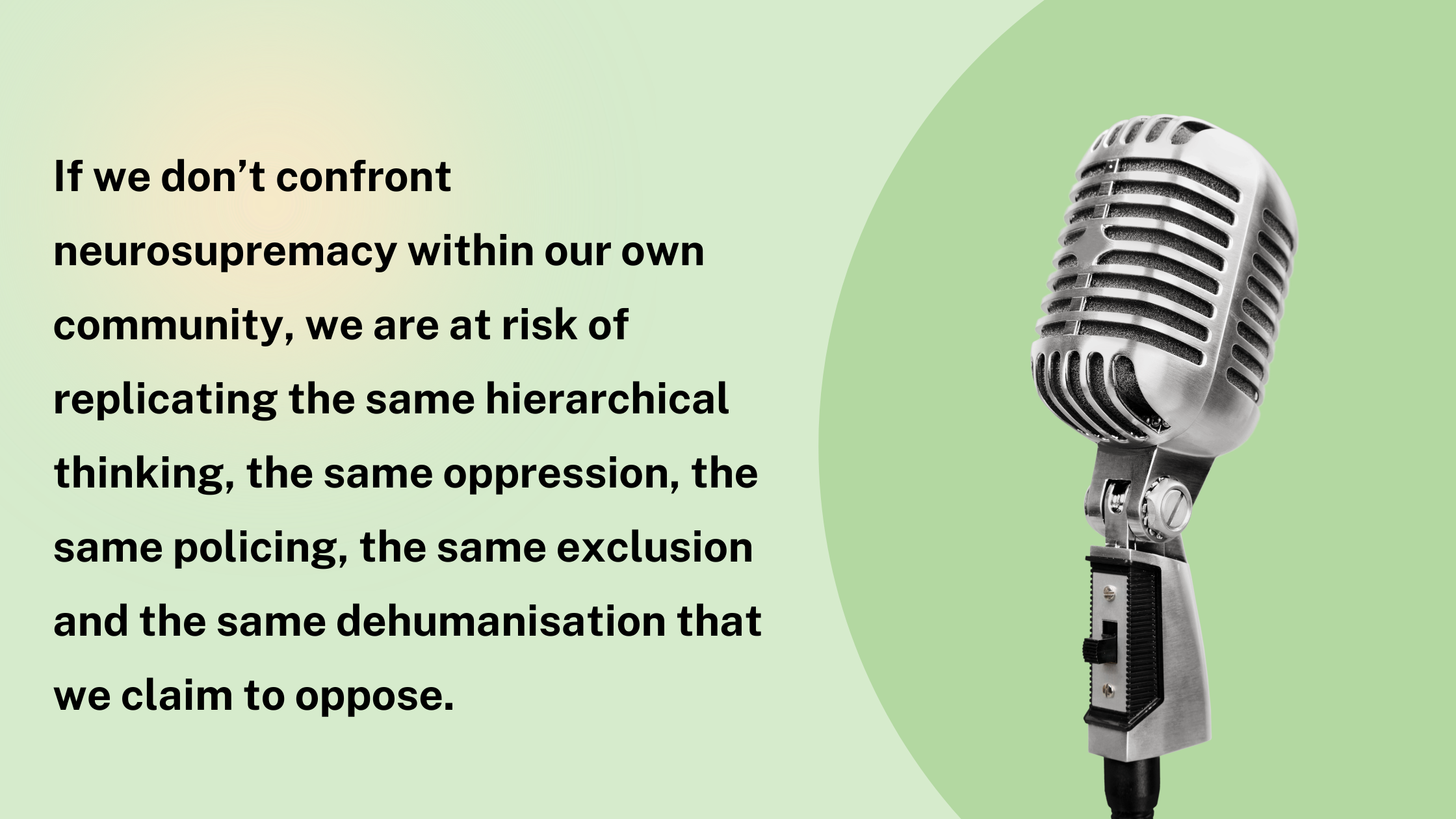
If we don’t confront neurosupremacy within our own community, we are at risk of replicating the same hierarchical thinking, the same oppression, the same policing, the same exclusion and the same dehumanisation that we claim to oppose.
If the neurodivergent movement is to remain a movement of liberation, we must confront neurosupremacy within our own communities and we must recognise that neurodivergent liberation and neuroinclusion cannot be built on conditional acceptance and implementing new hierarchies.